Bio
Pablo Devigo is a conductor and historical keyboardist whose work bridges over four centuries of musical tradition through innovative interpretive approaches.
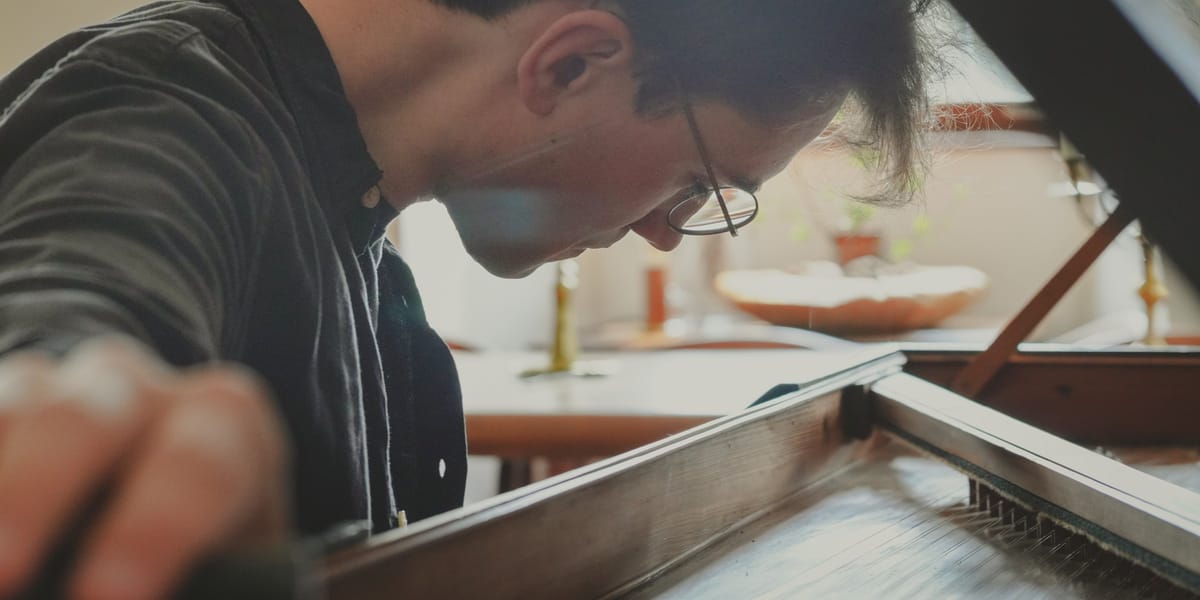


Praised for performances “tremendously alive, full of nuance, colour and contrast” (Ritmo), Spanish conductor Pablo Devigo has been a regular guest on the podium of the Real Filharmonía de Galicia. A finalist at the Hugo Alfvén (Falun, 2026) and Khachaturian (Yerevan, 2021) international conducting competitions, he also reached the second round at Besançon and at the Toscanini competition in Parma (2021). In 2018 the Aspen Music Festival welcomed him as a Conducting Fellow.
He has served as assistant conductor of the Carmel Symphony Orchestra and Indiana University Opera, assisting maestros such as Paul Daniel and receiving advice from Bernard Haitink, Fabio Luisi and Robert Spano, among others.
Trained in composition and conducting at the Conservatory of the Principality of Asturias, where he graduated with Extraordinary Prize and Highest Honors, Devigo furthered his education as a Fulbright Scholar (2015–2017) at the Cleveland Institute of Music and continued doctoral studies at Indiana University under Arthur Fagen, earning a Doctor of Musical Arts in Orchestral Conducting (2025) with a dissertation on Spanish theatre music from the Golden Age. His pursuit of historical performance expertise led him to the Royal Academy of Music in London and the Royal Conservatoire of The Hague.
In 2022 he founded Música d’Outrora, a UK-based ensemble dedicated to historical recovery and innovation, and has collaborated with renowned conductors including Bernard Haitink at the Lucerne Festival and William Christie. The ensemble’s award-winning debut recording Still Life (Deux-Elles, 2025) presents a fresh perspective on the 17th-century Italian stylus fantasticus tradition.
Pablo Devigo’s artistic vision continues to gain international recognition as he creates meaningful dialogues between historical repertoire and contemporary audiences, offering new aesthetic and poetic interpretations that connect past and present.